Tuesday, December 22, 2020

2000 doves

 https://cathedral.org/visit-us/doves/

Maybe it should have been 2021 doves. I wonder if there is a video of them moving with the air currents.


Monday, September 7, 2020

Origami parabolas!?

             Last time I mentioned a fold that was equivalent to the shared tangent of two parabolas. In this article, I’d like to talk more about parabolas and origami - finding a parabola’s tangent is actually quite common in origami.

You might know that a parabola is the shape of a graph of a quadratic function; that is, the graph of something in the form of y=ax^2+bx+c.

You might also have heard of parabolas in the context of parabolic reflectors, where rays of light or sound emanating from one point are reflected parallel to each other or vice versa.

Parabolas in origami occur because of another definition of a parabola: the set of all points equidistant from a point (called the parabola’s “focus”) and a line (called the parabola’s “directrix”).

Okay, okay, maybe this is too obtuse and it seems like it’s not going anywhere, but let me explain. When you fold two points so they lie on top of each other, you get the perpendicular bisector of the segment containing the two points, that is, the set of all points equidistant from the two original points. Now, if you keep one of the original points fixed and move the other point around in a line, it stands to reason that the lines will all have a point that’s on a parabola - the parabola whose focus is the fixed point and directrix is the line on which the other point is moving.

Perhaps it’s time for the algorithm. Draw a point close-ish to one of the sides of a piece of paper. Then, take that side and fold it so that when it lands, it goes through the point. Make many folds of this type. Eventually, you should see a parabola emerge - there’ll be a heavily creased region, and a region without any creases, and the boundary between the two is a parabola.


Tuesday, July 21, 2020

How to trisect an angle with origami

There are a couple things that can’t be done with a compass and straightedge - squaring a circle, doubling a cube, finding the distance from a point to an ellipse.

Among these is the task of trisecting a given angle. However, despite not being able to be done using classical methods, origami has an algorithm for this construction.


It begins with the angle drawn from the corner (I will, WLOG, refer to the example with the angle in the bottom right corner) of the piece of paper with one ray lying on the paper’s edge and the other ray marked or folded. A fold is made parallel to the edge of the paper with the angle’s ray on it, close to the top. Then, the bottom half of the paper is folded in half.

Next, the point at the intersection of the top fold and the left edge of the paper and the vertex of the angle are folded in such a way that they meet the angle’s ray and the bottom horizontal fold, respectively.

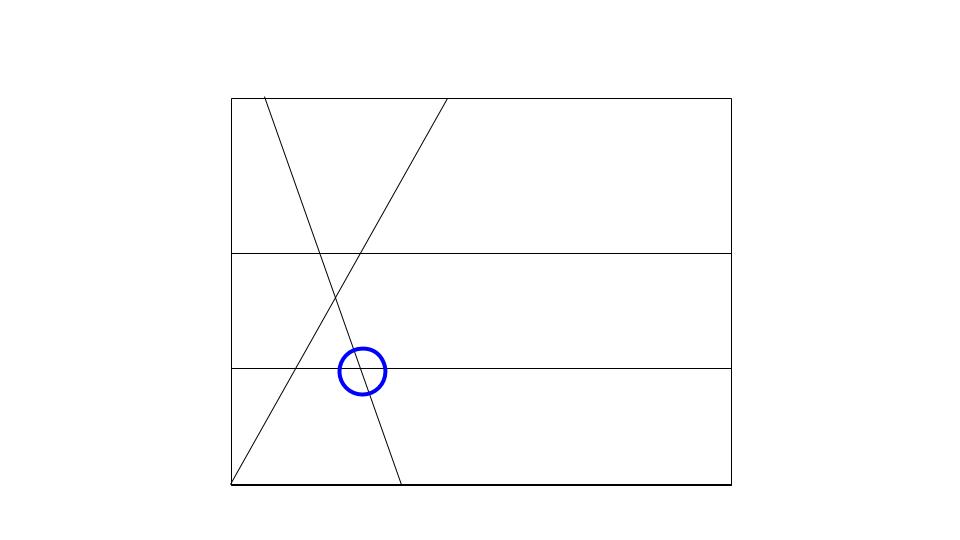


Finally, if you fold from the corner to the point where the diagonal fold intersected the bottom horizontal fold and the point where the angle’s vertex landed, on the bottom horizontal fold, you will get two more lines that perfectly trisect your original angle.


Now, here’s the crucial question: What did using origami add that a straightedge and compass couldn’t? Well, it was that diagonal fold. It added what would amount by straightedge and compass to an infinite amount of information. That fold maps to finding the shared tangent of two parabolas, which requires a cubic equation, which cannot be done using Euclidean methods. Indeed, origami is even more powerful than straightedge and compass.


Sunday, July 19, 2020

Origami, Geometry, and Math

Origami, Geometry, and Math have many shared concepts and uses.  Other subjects sometimes taught separately such as Algebra and its advanced topics blend right into Calculus.  Math in its many manifestations are representations of the same underlying concepts; for example, (a+b) squared, can be worked out with algebra, but it can also be represented in squares and rectangles of a square with a side of length (a+b). https://www.mathdoubts.com/a-plus-b-whole-square-geometric-proof/   Using either the geometry or the algebra, the answer turns out to be the same.  Why? it's the same underlying idea, we are looking at and solving the same problem through either an algebra viewing lens, or a geometry viewing lens.

Origami of course is closest to geometry in physical appearance. There are, however, things that can be easily done with origami that are hard to do with conventional tools of geometry (straightedge, compass), such as trisecting an arbitrary angle.  See https://plus.maths.org/content/trisecting-angle-origami for details. 

Starting with basic constructions, it is possible to arrive at either exact 30 and 60 degree angles, or usable approximations of a 72 degree angle (a whole 360 degree circle divided into fifths), and those useful approximations can be used in origami construction that are sometimes clumsy using a protractor and ruler.

Coming back to the original point, Origami, Geometry, Algebra, Calculus and other aspects of Mathematics are simply different viewing lenses, or windows with which we look at a set of concepts and principles.  Sometimes Origami can give us an angle that is useful and pleasing to look at.


Saturday, January 5, 2019

Win $1000 with origami airplane, and flapping wings

If you can beat the existing distance record with this paper airplane design you can win $1000 prize noted in the description:  https://www.documentcloud.org/documents/4427293-How-to-Fold-a-World-Record-Holding-Paper-Airplane.html .

Even more fun: the Bat Plane even flaps its wings while flying.  I can't wait to try them all.

John Collins is featured in WIRED magazine
https://www.wired.com/story/how-to-fold-paper-airplanes/
and is a YT feature:
https://www.youtube.com/watch?v=3BNg4fDJC8A&feature=youtu.be


Sunday, September 2, 2018

PBS Nova show on Origami Revolution

https://www.pbs.org/video/nova-origami-revolution-episode/

from the posting:
Program Description
The centuries-old tradition of folding two-dimensional paper into three-dimensional shapes is inspiring a scientific revolution. The rules of folding are at the heart of many natural phenomena, from how leaves blossom to how beetles fly. But now, engineers and designers are applying its principles to reshape the world around us—and even within us, designing new drugs, micro-robots, and future space missions. With this burgeoning field of origami-inspired-design, the question is: can the mathematics of origami be boiled down to one elegant algorithm—a fail-proof guidebook to make any object out of a flat surface, just by folding? And if so, what would that mean for the future of design? Explore the high-tech future of this age-old art as NOVA unfolds “The Origami Revolution.”

Monday, May 14, 2018

"soccer ball" geodesic sphere

How about that I can still make this one.
Soon on its way to Jon Dietz.
Start with 90 squares, 10 pieces each of nine colors

Make each W shape and fold in half

Fold the PHZZ (pentagon hexagon zig zag) units

start assembly


Add some pieces

And some more


And some more


The geodesic sphere is taking shape

More like a sphere


Closer and closer


Closing in


Just a few pieces left


Ta-Da!  the completed sphere, all ninety pieces in place

Video just for fun:

Friday, December 1, 2017

origami muscles

https://www.theverge.com/2017/11/27/16705062/soft-robot-muscles-origami-skeleton-mit-harvard


Soft robot muscles with origami skeletons can lift 1,000 times their own weight

Finally, soft robots with a little backbone
by James Vincent@jjvincent Nov 27, 2017, 3:00pm EST
  The soft muscles have rigid skeletons that allow them to lift heavy payloads. Image: MIT / Shuguang Li


Soft robotics has been a promising field of research for years, but these squidgy and flexible creations have been held back by the absence of one important characteristic: strength. Now, scientists from MIT CSAIL and Harvard’s Wyss Institute have come up with a way to give soft robots some power — by outfitting them with rigid origami skeletons.

In a paper published today in the journal PNAS, researchers describe a new type of soft artificial muscle that could be used to build soft robots. Each muscle consists of a sealed bag filled with air or fluid, containing a folding origami structure that functions as the skeleton. When the pressure inside the bag is reduced using an electric pump, the whole structure collapses and contracts, just like the muscles in your arm or leg. It may not sound like a recipe for strength, but these artificial muscles are much stronger than their human counterparts, capable of lifting 1,000 times their own weight.

“Soft robots have so much potential, but up until now, one of the limitations has been payloads,” Professor Daniela Rus, CSAIL director and lead author of the paper, tells The Verge. “[They’re] very safe, very gentle, but not good for lifting heavy objects. This new approach allows us to make strong and soft robots.”


The muscles have a number of potential uses, most obviously within warehouses and logistic operations, where they can safely handle breakable and delicate objects like fruit. They’re also well-suited for picking up objects with unusual shapes — a challenge so persistent in the robotics that Amazon holds an annual competition to try and solve it.

Some researchers use grabbers like suction cups to handle irregular shapes, while others apply AI to try and calculate the best way to grasp their target. Soft robots, though, can simply reach out and grab, trusting that the deformable shape of their gripper will mold around the target. In this regard they’re similar to human hands, says Rus, which can “wrap around the object, no matter what shape it is.” The new origami skeleton would make such soft grabbers more useful, by allowing them to handle weightier objects.

The new muscles have their drawbacks, though. The biggest being that they’re not as easily controlled or as reprogrammable as traditional robots. The direction they move in is entirely dictated by their inner structure and once created, can’t be changed. “You compose distinct movement patterns inside the skeleton that define how the system as a whole moves,” says Rus. In other words, if you fold the inner origami structure like this or like that, you can get it to collapse in any direction you like. Another potential design built from the new soft artificial muscles. Image: MIT

This isn’t as limiting as you might think, though. We can use algorithms to find origami patterns that fold in near-infinite ways, so that these muscles can carry out even complicated motions, like twisting. (This being potentially useful in assembly lines.) However, this still means these artificial muscles aren’t as dynamic or adaptable as more traditional industrial robots.

They balance this with other benefits. For a start, because the way the muscle moves is defined by its structure, it doesn’t need a complicated electronic control system to tell it what to do — just something to turn it on or off. The muscles can also be built out of a range of cheap, lightweight materials, meaning they can be quickly fabricated and easily repaired. This means they could be used to build inexpensive exoskeletons which we would strap onto our body to increase our own strength.
“origami has this beautiful universality.”

For Rus, though, the real magic is how easily these muscles can be combined and redesigned to create new forms of lifting, pushing, and pulling machines. “I started working with origami many years ago because I was interested in making modular robots that have programmable properties; I wanted to create programmable matter,” she says. Since then, she’s used origami to program movement into all sorts of creations — from tiny robots with flat-pack exoskeletons to ingestible machines that unfold in your stomach. “Origami has this beautiful universality,” says Rus.

But because of their strength and the ease with which they can be joined together, these artificial muscles might have the most potential. “We’ve shown a combination of four muscles that forms an arm with a gripper that can pick up a tire,” says Rus. “If we put a joint there and added another arm, which is quite easily done, we would be able to not just lift up the tire, but move it and place it anywhere.”

And what’s next for the team? Building a soft robot elephant trunk that’s “as flexible and powerful” as a real elephant’s. “It’s as big as a human person,” says Rus.

Thursday, September 7, 2017

Fold, wait, Unfold Your Clothes!


Watch this -  sign up to be notified when they become available..

http://petitpli.com/buy.html