Thursday, September 7, 2017
Fold, wait, Unfold Your Clothes!
Watch this - sign up to be notified when they become available..
http://petitpli.com/buy.html

Saturday, August 12, 2017
Monday, July 4, 2016
new origami canoe
http://www.fastcoexist.com/3061388/this-origami-inspired-canoe-folds-up-so-small-you-can-take-it-on-the-subway (see earlier post on http://ourigami.blogspot.com/2013/07/fold-kayak_15.html )
This Origami-Inspired Canoe Folds Up So Small You Can Take It On The Subway
Even if you have the tiniest apartment, the Onak canoe will let you get out on your local waterways.

This Origami-Inspired Canoe Folds Up So Small You Can Take It On The Subway
Even if you have the tiniest apartment, the Onak canoe will let you get out on your local waterways.
Tuesday, March 15, 2016


Sunday, March 13, 2016


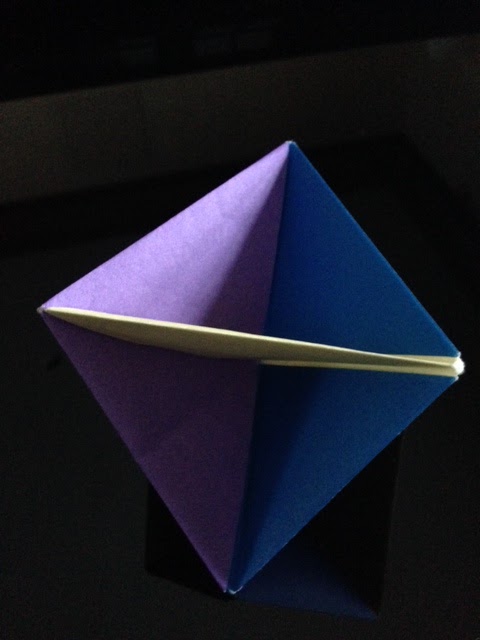


Saturday, December 12, 2015
Monday, September 21, 2015
self assembling origami robot, walks, swims,
Watch this:
humans are doomed
https://www.youtube.com/watch?t=3&v=Qb5UIPeFClM
and other
robots: https://www.youtube.com/watch?t=328&v=S5AnWzjHtWA
Thursday, February 12, 2015
folding DNA
from meetup: (see the hexaflexagon at http://youtu.be/dES-ozV65u4?t=5m38s)
CafeSci Boston - “Studying Genomic Origami"
Tuesday, February 17, 20157:00 PM to 8:30 PM
Cafe Artscience
650 Kendall St, Cambridge, MA (map)
Lecture is in hall inside the Cafe Artscience restaurant. (Not in the gallery on the left.)
“Studying Genomic Origami"
with Miriam Huntley
Le Laboratoire Cambridge 650 East Kendall Street Cambridge, MA 02142 How is it that every cell inside our body has the exact same DNA, and yet an eye cell performs a very different function from a blood cell? It turns out that different cells fold up their DNA in different ways, much in the same way an origami artist will fold up the same piece of paper in different ways in order to create different shapes. I'll talk about some of our recent work done in the Aiden Lab which sheds light on the exciting mystery of how the genome folds. Miriam Huntley is a doctoral student at Harvard University's School of Engineering and Applied Sciences. View the Aiden Lab's unique video explaining their research here
CafeSci Boston - “Studying Genomic Origami"
Tuesday, February 17, 20157:00 PM to 8:30 PM
Cafe Artscience
650 Kendall St, Cambridge, MA (map)
Lecture is in hall inside the Cafe Artscience restaurant. (Not in the gallery on the left.)
“Studying Genomic Origami"
with Miriam Huntley
Le Laboratoire Cambridge 650 East Kendall Street Cambridge, MA 02142 How is it that every cell inside our body has the exact same DNA, and yet an eye cell performs a very different function from a blood cell? It turns out that different cells fold up their DNA in different ways, much in the same way an origami artist will fold up the same piece of paper in different ways in order to create different shapes. I'll talk about some of our recent work done in the Aiden Lab which sheds light on the exciting mystery of how the genome folds. Miriam Huntley is a doctoral student at Harvard University's School of Engineering and Applied Sciences. View the Aiden Lab's unique video explaining their research here
Friday, August 8, 2014
Wednesday, March 12, 2014
folding pop up robots
https://www.americanscientist.org/issues/feature/2014/2/the-challenge-of-manufacturing-between-macro-and-micro
The Challenge of Manufacturing Between Macro and Micro
Classic ways of folding paper into dynamic shapes—origami, pop-up books—inspire methods to engineer millimeter-scale machines. Robert J. Wood
In the current trend toward miniaturization, the sizes in between “normal” and “microscopic” get a bit neglected. Wood discusses various methods that his group has developed to construct electromechanical devices with feature sizes in the millimeter range, which he calls the meso-scale. He particularly describes work on devices inspired by children’s pop-up books, where items are formed flat using laser cutting and then folded into 3D shapes. By sandwiching layers and using movable folds, Wood can create functional devices such as small flying robots, surgical instruments, or environmental sensors.

The Challenge of Manufacturing Between Macro and Micro
Classic ways of folding paper into dynamic shapes—origami, pop-up books—inspire methods to engineer millimeter-scale machines. Robert J. Wood
In the current trend toward miniaturization, the sizes in between “normal” and “microscopic” get a bit neglected. Wood discusses various methods that his group has developed to construct electromechanical devices with feature sizes in the millimeter range, which he calls the meso-scale. He particularly describes work on devices inspired by children’s pop-up books, where items are formed flat using laser cutting and then folded into 3D shapes. By sandwiching layers and using movable folds, Wood can create functional devices such as small flying robots, surgical instruments, or environmental sensors.

Subscribe to:
Posts (Atom)